
Hawaii Obituary Records
A Hawaii obituary helps families and researchers find key facts about a death in the islands. The State of Hawaii keeps death records at the Department of Health in Honolulu, while obituary notices live in local papers like the Honolulu Star-Advertiser, The Maui News, and Hawaii Tribune-Herald. You can search an obituary online, by mail, or in person at a county health office. This page shows you how to look up a Hawaii obituary, where to get a certified death certificate, and which state and county sources hold the most useful records for each island.
Hawaii Obituary Records Overview
How to Find Hawaii Obituary Records
Most families start an obituary search with a newspaper. Each island has its own paper. The Honolulu Star-Advertiser obituary page covers Oahu. The Maui News obituary section prints obituaries for Maui County. The Hawaii Tribune-Herald obituary page serves the Big Island, and The Garden Island posts Kauai obituaries. Each paper posts daily obituaries online for free. You can search an obituary by last name or scroll by date.
If you need more than an obituary, you want a death certificate. Death certificates in Hawaii are held by the Hawaii Department of Health, Office of Health Status Monitoring. The main office sits at 1250 Punchbowl Street in Honolulu. You can order online, by mail, or in person. The fee is $10 for the first copy and $4 for each extra copy of the same record, plus a $2.50 order fee. Access is limited under HRS §338-18 to people with a direct and tangible interest in the record.
The Hawaii State Public Library System keeps obituary indexes on microfilm and online. Anyone with a library card can log in. The Hawaii Newspaper Index goes back to 1989 and covers the Honolulu Advertiser, the Star-Bulletin, and the current Star-Advertiser. Older obituaries may only show up in print indexes at the main reference desk.
The Hawaii State Public Library System is the front door for most research. The library runs branches on every island and shares print and digital tools statewide.
The Hawaii State Public Library System connects branches on Oahu, Hawaii Island, Maui, Molokai, Lanai, and Kauai to shared research tools.

Branch staff can help pull old Hawaii obituary microfilm and direct you to Ancestry Library Edition for deeper searches.
Note: A Hawaii obituary is not the same as a death certificate. The obituary is a news notice, and the certificate is a legal record held by the Department of Health.
Hawaii Department of Health Death Records
The Office of Health Status Monitoring keeps all Hawaii death records from 1896 to today. Registration of deaths was first required by law in 1859, but few records exist before the Department of Health took over in 1896. The office holds Oahu and Kauai records back to 1862 and Hawaii, Maui, and Molokai records back to 1896.
There are three ways to order a certified death certificate. The online option uses the Hawaii Vital Records Ordering Portal at vitrec.ehawaii.gov. Orders by mail go to: State Department of Health, Office of Health Status Monitoring, Issuance/Vital Statistics Section, P.O. Box 3378, Honolulu, HI 96801. In-person visits are Monday through Friday from 7:45 a.m. to 2:30 p.m. Processing can take 6 to 8 weeks, so plan ahead. A Letter of Verification may be issued in place of a certified copy under HRS §338-14.3 for a $5 fee.
The Hawaii Electronic Death Registration System (EDRS) is how funeral directors, medical certifiers, and registrars file the death itself. Families do not use EDRS, but the data flows into the state index that feeds every future search. Learn more about genealogy access on the Hawaii DOH Genealogy Requests page.
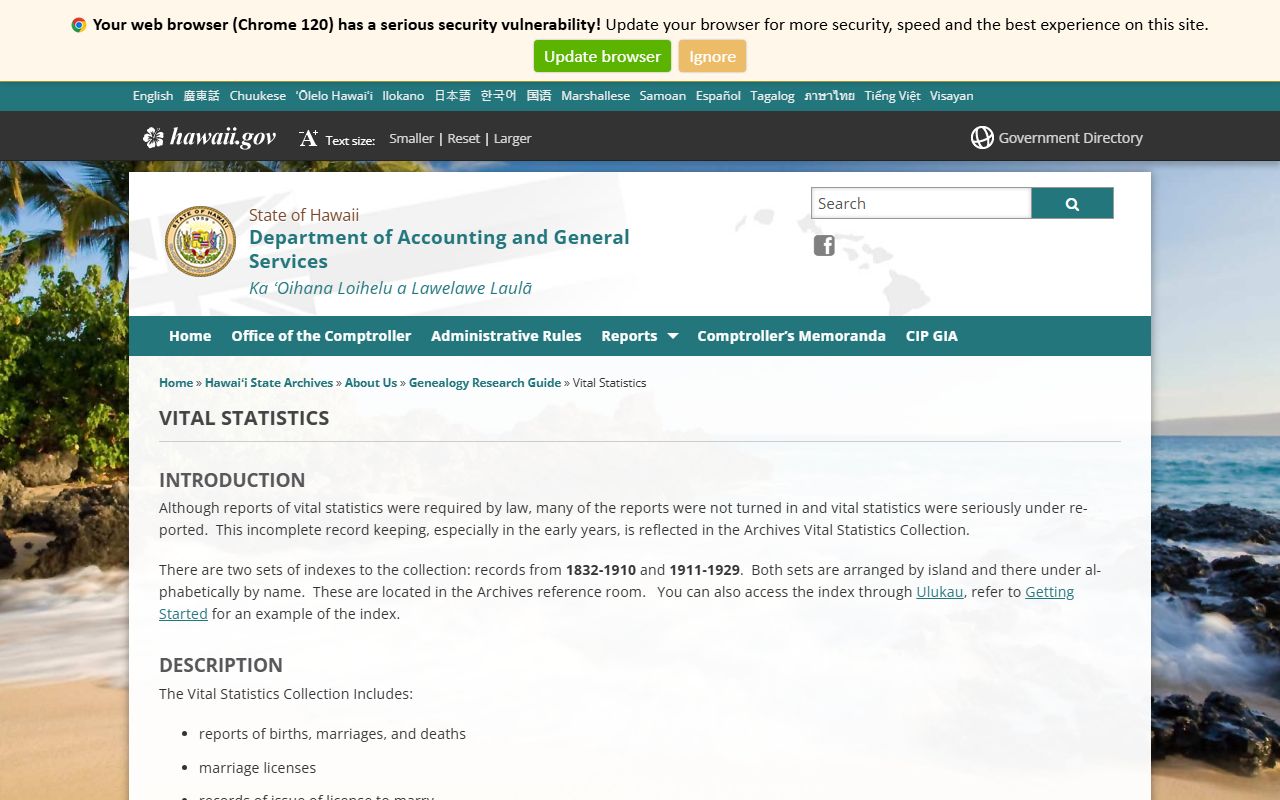
For events more than 115 years old, the DOH refers researchers to the Hawaii State Archives Vital Statistics Collection for genealogy work.
Index data like name, age, sex, date of event, and file number can be shared with the public. Full records stay closed for 75 years under HRS §338-18. After 75 years, the records open up for research use.
Newspaper Obituaries in Hawaii
Newspapers print the obituary you will see most often. A Hawaii obituary usually lists the full name, age, city of residence, date of death, place of death, date of birth, birthplace, job history, family survivors, and the funeral home handling the service. Some obituaries include photos and a short life story. Obituary length varies from a few lines to several paragraphs.
The BYU-Hawaii Joseph F. Smith Library hosts a huge obituary database for the state. The BYU-Hawaii Obituaries Collection holds records from the Honolulu Advertiser, Honolulu Star-Bulletin, Kauai Garden Island News, The Maui News, and Hawaii Tribune-Herald. Names in all caps came from the Advertiser. Names in mixed case came from the Star-Bulletin. The current year updates daily so you can find recent Hawaii obituaries without waiting.
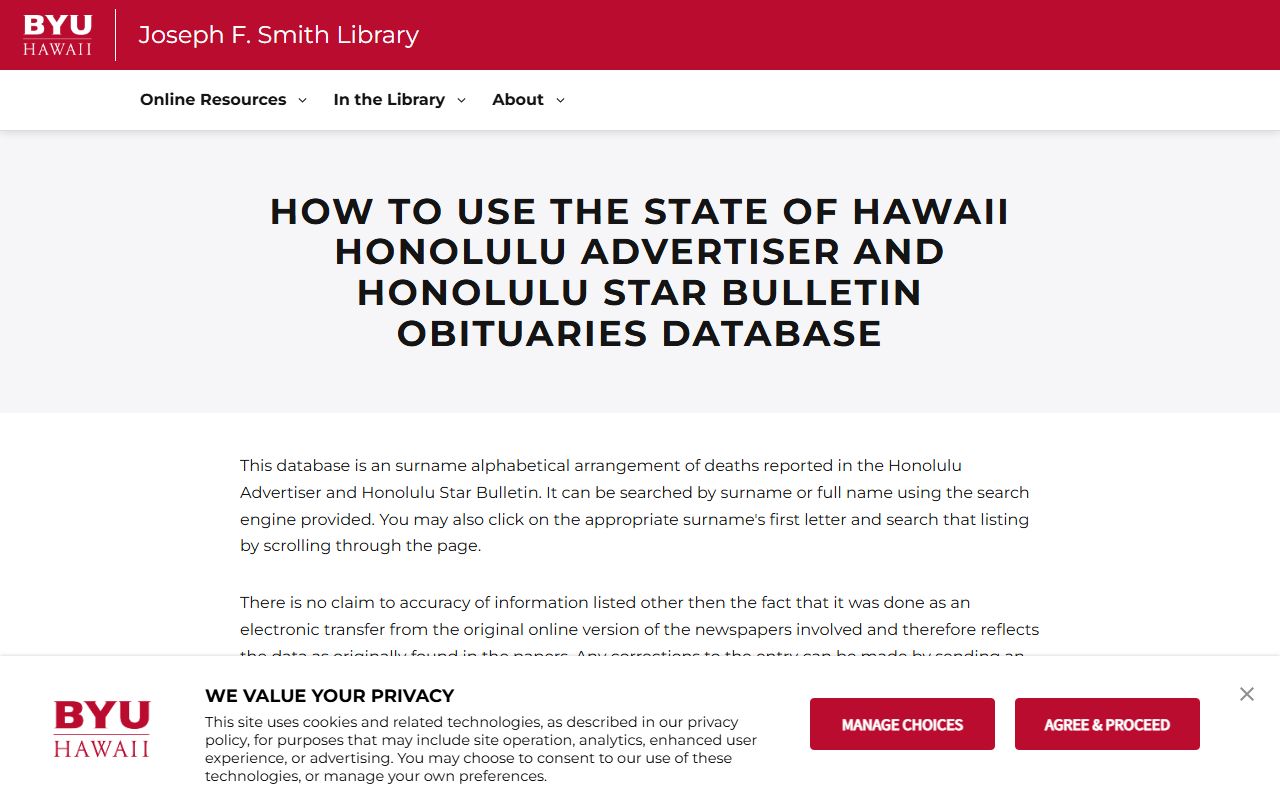
Volunteers at the library transcribe obituary notices week by week. Some entries are in the Hawaiian language.
Each county has its own paper. The Honolulu Star-Advertiser was formed from the merger of the Honolulu Advertiser and the Honolulu Star-Bulletin and prints daily obituaries for Oahu. Maui Now runs an obituary portal alongside The Maui News. On the Big Island, Hilo families watch the Hawaii Tribune-Herald for services held at Dodo Mortuary, Homelani Memorial Park, and Ballard Family Mortuary. On Kauai, the Garden Island prints obituaries tied to Wilcox Medical Center and Samuel Mahelona Memorial Hospital.
Note: A Hawaii obituary is written by the family, so a missing detail is not proof the fact is wrong. Check the death certificate for official data.
Hawaii State Archives Death Records
The Hawaii State Archives Vital Statistics Collection holds early birth, marriage, and death records from 1826 to 1929. The reference room sits in the Kekauluohi Building on the Iolani Palace Grounds, at 364 South King Street, Honolulu, HI 96813. You can call the reference desk at (808) 586-0329 to ask about a specific name.
Records are filed by island with a letter code. H means Hawaii Island (1832-1929). K means Kauai (1826-1929). M means Maui (1842-1929). Mo stands for Molokai (1850-1929). N is Niihau (1849-1856). O is Oahu (1832-1929). Indexes cover two ranges: 1832-1910 and 1911-1929. Both are alphabetical by name.
The Digital Archives of Hawaii puts many old vital records online. You can browse individual Hawaii, Kauai, Maui, and Molokai death records from 1904 to 1919. Each item shows an image file name, a unique ID, the island, and a short source description. A search for "obituaries" returns around 135 matches across the collection.
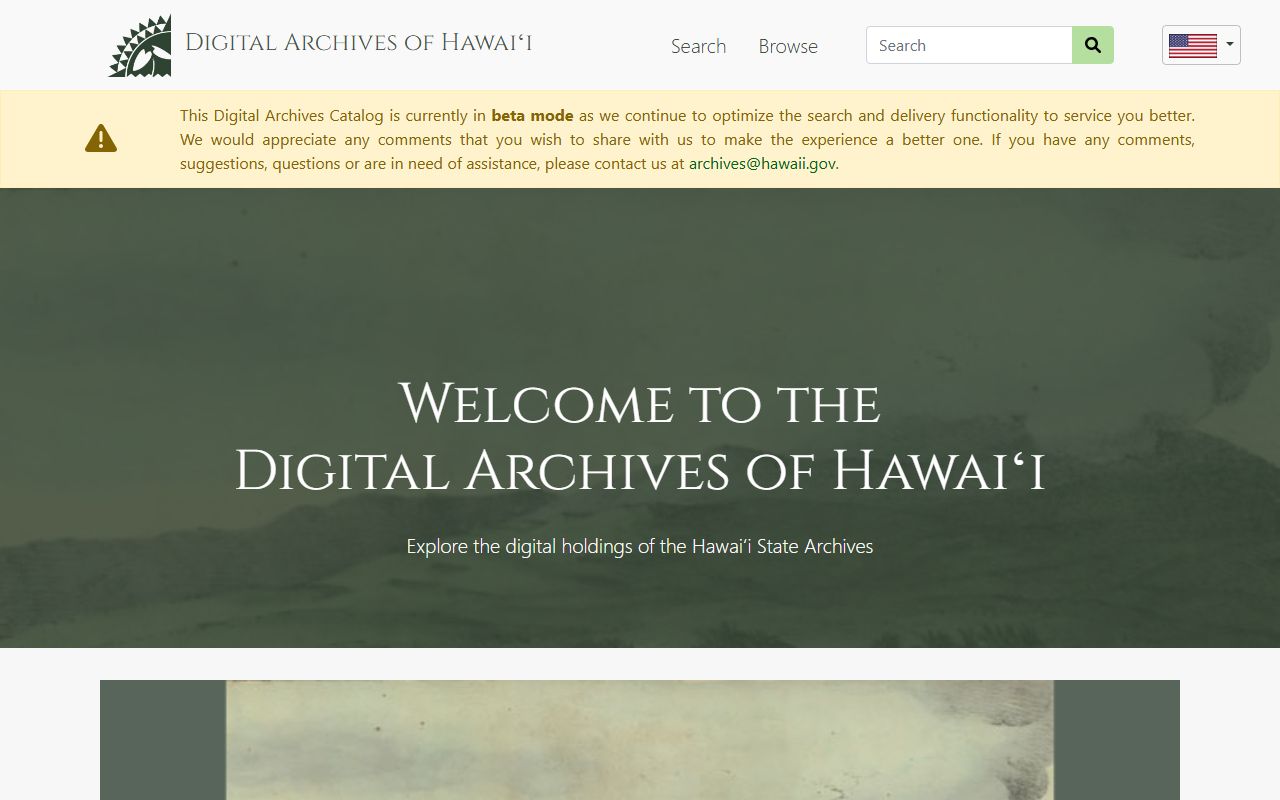
The digital site runs around the clock, so you can search an obituary record at any hour.
Newspapers on microfilm sit at the Archives too. Holdings include The Friend (1843-1954), the Hawaiian Gazette (1865-1913), the Honolulu Advertiser and Honolulu Star-Bulletin before 1900, The Independent (1895-1905), Ka Hae Hawaii (1856-1861), and the Pacific Commercial Advertiser (1856-1884). Reference staff can help you pull the right reel.
The University of Hawaii at Manoa genealogy guide points to the same archives and shows how to read a vital statistics reference number.
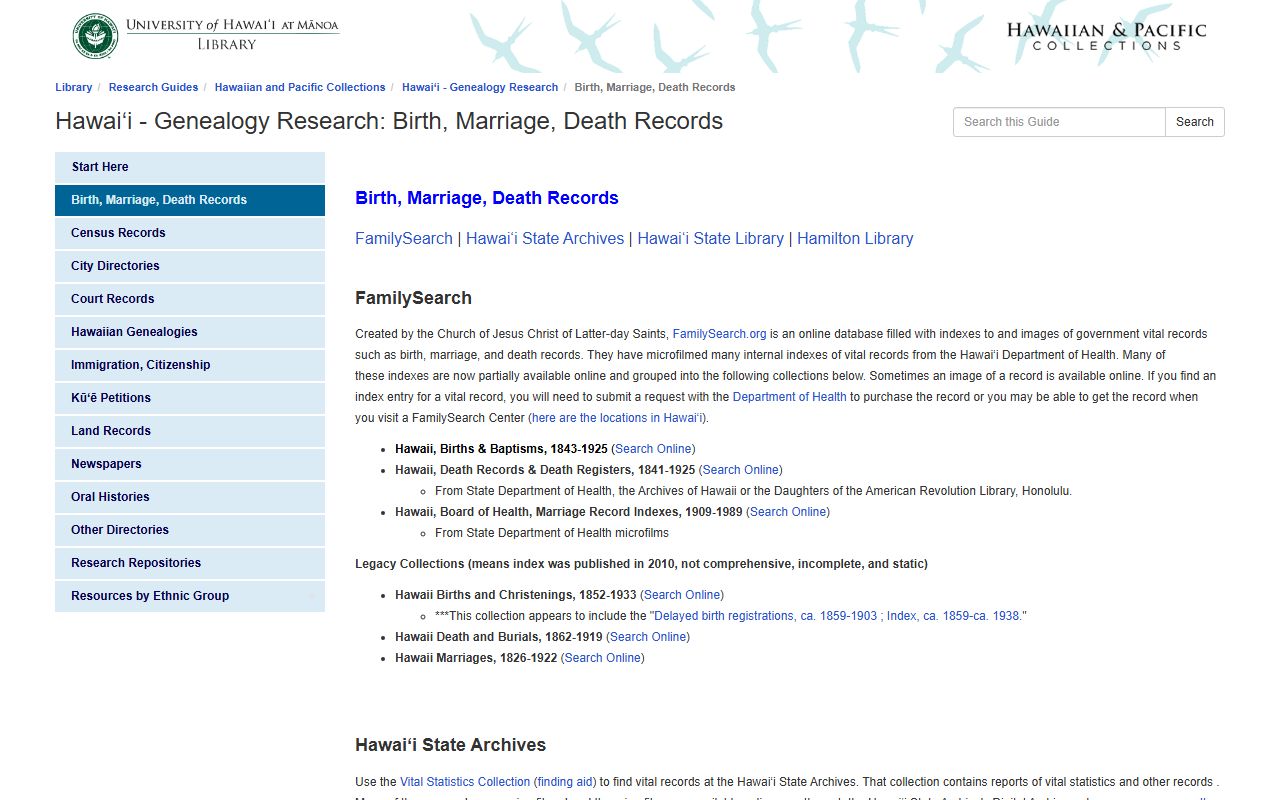
The letter stands for the island, the next number is the volume, and the next is the page.
County Health Offices for Hawaii Obituaries
Death certificates are only issued by the state office on Oahu. But county District Health Offices can help with forms, pick-ups, and local guidance. They register home births and issue permits for burials and cremations.
On the Big Island, the Hawaii District Health Office serves Hilo and Kamuela. The Hilo office is at 75 Aupuni Street, Suite 201. The Kamuela office offers pick-up Monday, Wednesday, and Friday from 9 a.m. to 2 p.m. by appointment only. On Maui, the Maui District Health Office is at 54 South High Street, Room 301 in Wailuku. Note that no pick-up service is available on Maui.
The Kauai District Health Office is at 3040 Umi Street in Lihue. Staff can issue birth and marriage certificates for online orders, but death certificates must come from the Oahu office. Call (808) 241-3498. Hours run 7:45 a.m. to 4:30 p.m.
Each county paper ties local obituaries to local funeral homes. You will see repeat references to Hosoi Garden Mortuary on Oahu, Dodo Mortuary in Hilo, Nakamura Mortuary in Wailuku, and Kauai Memorial Gardens in Lihue.
Historical Hawaii Obituary Indexes
Obituaries first appeared in Hawaii newspapers as early as 1836. The Hawaii State Archives keeps an obituary index from 1836 to 1950. Most entries came from English-language papers in Honolulu, but death notices for well-known people may be filed as news items instead, so you sometimes have to check the paper directly.
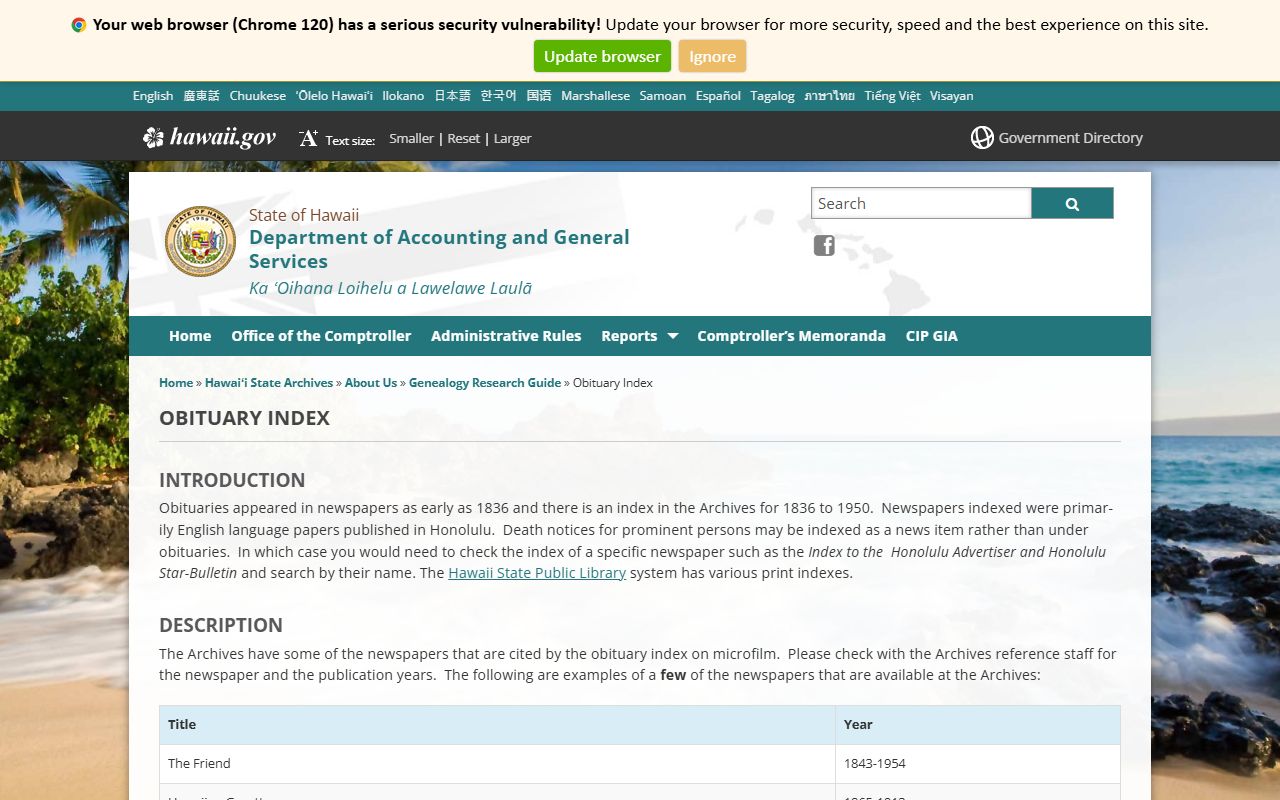
The index covers key sources like the Pacific Commercial Advertiser, the Friend, the Hawaiian Gazette, Ka Hae Hawaii, the Polynesian, and the Honolulu Star-Bulletin.
The Hawaii State Library System runs more indexes. The Honolulu Advertiser and Star-Bulletin Index covers 1929 to 1994. From 1929 to 1969 obituaries sit under "Deaths." From 1970 forward they sit under "Obituaries." The index from 1929 to 1969 is online at ulukau.org. Maui News indexes run 1900 to 1950 and 1951 to 1973. Obituaries appear under "Deaths" in those sets too.
Vital records microfilm covers 1909 to 1949 with a five-year alphabetical death index. Microfilm sits at the Hawaii State Public Library main branch at 478 South King Street in Honolulu. Call (808) 586-3535 for help. Copies of those indexes also sit at the Hilo, Kahului, Kaneohe, Lihue, and Kailua-Kona library branches, and at the University of Hawaii Hawaiian Collection.
Hawaii Cemetery and Burial Records
Cemetery records round out the picture. A headstone shows the dates of birth and death. A burial log may name the plot, section, and funeral home. Many Hawaii obituaries list the final burial site, which lets you match the paper notice to a cemetery record.
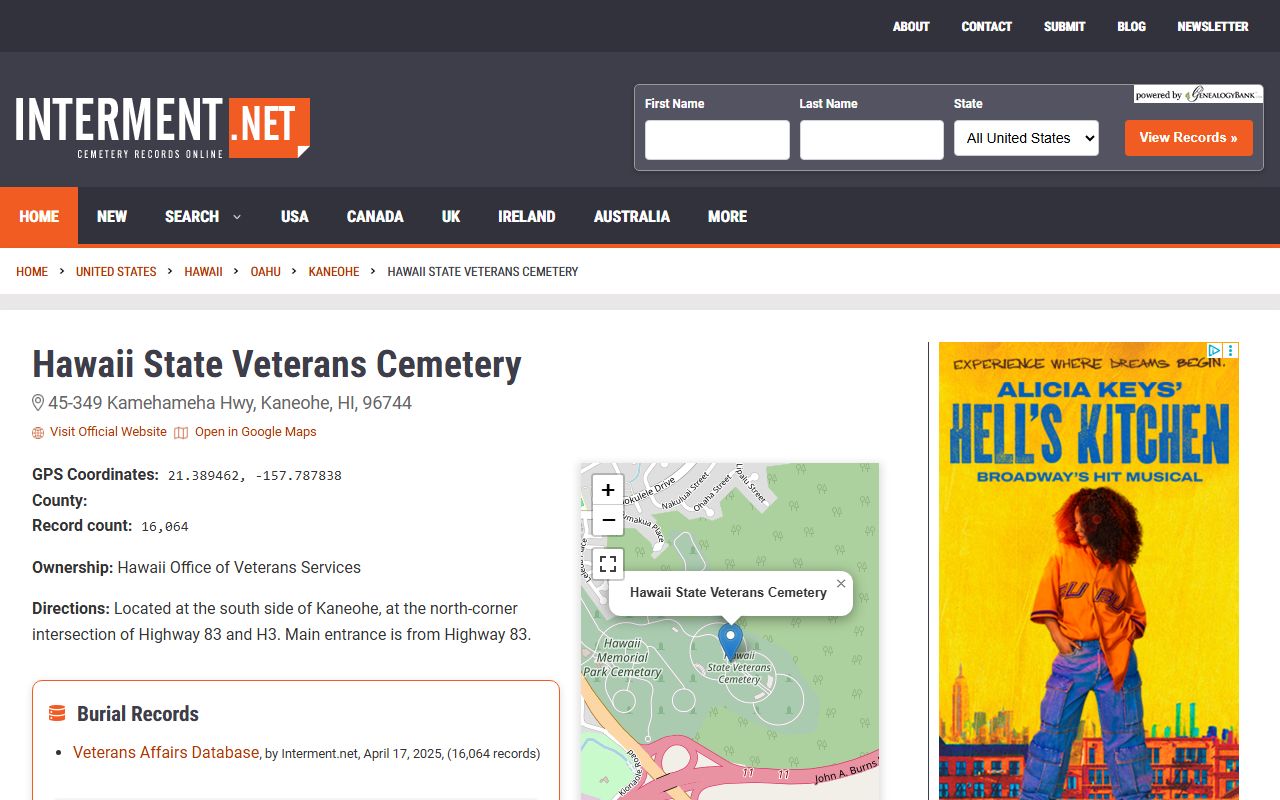
The Hawaii State Veterans Cemetery in Kaneohe holds 16,064 burial records. The site is at 45-349 Kamehameha Highway, at the north-corner of Highway 83 and H3. The Hawaii Office of Veterans Services owns the grounds.
The National Memorial Cemetery of the Pacific, known as Punchbowl, holds more than 53,000 burials from World War I through later conflicts.
The Hawaii Department of Commerce and Consumer Affairs licenses cemetery, burial park, mausoleum, and columbarium operators. Every license renews by December 31 of each odd-numbered year. The on-time fee is $788 for a cemetery license and $788 for a pre-need funeral authority. Restoration after a late renewal is $828 and must happen within six months.
Real property records track ownership transfers after a death. The Hawaii Bureau of Conveyances at 1151 Punchbowl Street in Honolulu records all land documents statewide. An heir or executor may need to record a probate order here before a title changes hands.
Kalaupapa Hansen's Disease Death Records
Kalawao County is tiny, but its obituary history is deep. More than 8,000 people were sent to the Kalaupapa Settlement on Molokai between 1866 and 1969. Most died there. Twenty cemeteries mark the peninsula today.
The National Park Service runs a Kalaupapa Patient Register Search that indexes many of those lives. For patient medical records, contact the Hansen's Disease Branch by email at hansensdisease.doh@doh.hawaii.gov or by post at 3267 Kilauea Ave., Room 102, Honolulu, HI 96816. To ask about a marked grave, reach out to Kaohulani McGuire, Cultural Anthropologist at kaohulani_mcguire@nps.gov.
Families can also work with Ka Ohana O Kalaupapa's Restoration of Family Ties program. The program holds information on more than 7,300 people sent to or born at Kalaupapa. More than 900 family members have already been reunited with photos and records through this work.
Hawaii Obituary Laws and Public Access
Hawaii vital records sit under Chapter 338 of the Hawaii Revised Statutes. HRS §338-18 is the rule that matters most. It restricts who can inspect a particular record. The DOH must be satisfied that the person asking is the registrant, a spouse, parent, descendant, common ancestor, legal guardian, personal representative, or someone acting on their behalf.
HRS §338-14.3 covers letters of verification. If you do not qualify for a full certified copy, the state may issue a letter that confirms the event and the basic facts you provide. The fee is $5. HRS §338-30 sets the penalty for making a fake record. Medical examiners, like Honolulu's office, operate under HRS §841-14.5, which lays out board certification rules for forensic pathologists.
For events older than 75 years, the 1990 Hawaii Office of Information Practices opinion confirms that records and index information are open for public inspection. Genealogy access opens at 75 years for the public and 115 years for full genealogy requests.
The Hawaii Health Data Warehouse shares death statistics pulled from death certificates. The 2024 count was 12,883. In 2023 the state recorded 12,751 deaths. In 2020, the COVID year, the total reached 12,027. Cause of death is coded under the International Classification of Diseases, 10th Revision (ICD-10).
Online Hawaii Obituary Databases
Free online tools cover most of what families need. Ulukau, the Hawaiian Electronic Library, holds death probate indexes for all five circuits, will indexes, and court records. You can search by keyword. Ulukau partners with Hale Kuamoo, Ka Haka Ula O Keelikolani, the University of Hawaii at Hilo, and the Native Hawaiian Library at ALU LIKE.
Key statewide databases include:
- Digital Archives of Hawaii for 1904-1919 death records
- BYU-Hawaii Hawaii Newspaper Obituaries (1989-2013 archive)
- Hawaii Newspaper Index at the Hawaii State Library
- Ulukau Hawaiian Electronic Library probate indexes
- FamilySearch Hawaii Obituaries Index
The Windward Community College death records guide walks researchers through the process step by step. To submit a DOH application, you need the name on the certificate, the date of death, the place of death, and the names of both parents. Newspaper obituaries and cemetery indexes often supply the facts you are missing.
Most Hawaii obituary searches end at a newspaper site, a library microfilm reader, or the DOH ordering portal. Each source covers a different piece of the record trail.
Browse Hawaii Obituaries by County
Each of Hawaii's five counties runs its own health district office and local newspapers. Pick a county below to find local obituary sources for that area.
Hawaii Obituaries in Major Cities
Large cities on each island have their own funeral homes, libraries, and local obituary listings. Pick a city below to find local obituary sources.